

 ELITE
ELITE SWITCH POD SPLASH
 SWITCH POD
 AURA SPLASH
 AURA
AURA NOVA Apple Steezy
 NOVA Banana Steezy
 NOVA Popup Series
 NOVA Bubble Gang
 NOVA Lemon Steezy
 NOVA Series
 Blue Razz Steezy
 Mellow Man
 Apple Steezy
 Banana Steezy
 Berry Steezy
 DRT
DRT SWITCH POD
 Nicotine Pouches
Quick Answer
Vape detectors for schools are air-monitoring devices that detect vape aerosol, chemical compounds, and air quality changes in areas where cameras cannot be used, such as bathrooms and locker rooms. They help school administrators identify possible vaping incidents, respond faster, and support broader prevention programs.
Youth vaping remains a serious concern for schools. The FDA and CDC reported that current e-cigarette use among U.S. middle and high school students declined from 2.13 million in 2023 to 1.63 million in 2024, but millions of students have still used e-cigarettes recently, making prevention and enforcement a continuing priority.
Vape detectors are not magic devices, and they are not a replacement for education, counseling, or school policy. But when installed correctly, calibrated carefully, and paired with a thoughtful response plan, they can become an important part of a school’s health and safety strategy.
What Are Vape Detectors for Schools?
Vape detectors for schools are specialized sensors designed to identify airborne evidence of vaping. They are usually installed in places where adult supervision is limited but vaping is more likely to occur.
Common school locations include:
- Bathrooms
- Locker rooms
- Hallways
- Stairwells
- Cafeteria-adjacent areas
- Athletic facilities
- Transportation or bus areas
Unlike a standard smoke detector, a school vape detector is not mainly looking for combustion smoke or fire. It is looking for fine aerosol particles and chemical markers associated with electronic cigarettes and vaping devices.
A modern vape detector may detect:
- Vape aerosol particles
- Propylene glycol
- Vegetable glycerin
- Nicotine-related compounds
- THC-related vapor markers in some systems
- VOCs
- Humidity changes
- Air quality shifts
That means a vape detector is closer to an advanced air quality monitor than a traditional fire alarm.
Why Schools Are Installing Vape Detectors
Schools install vape detectors because vaping often happens in areas where cameras are not appropriate, such as restrooms. Administrators may know vaping is happening, but without a detection system, it can be difficult to identify when and where incidents occur.
There are several reasons schools are investing in vape detection systems.
1. Student Health Concerns
Health authorities consistently warn that nicotine can affect adolescent brain development. The CDC states that nicotine can harm parts of the adolescent brain involved in attention, learning, mood, and impulse control.
The FDA also states that nicotine in vapes can change the young brain and contribute to addiction risk.
This is one of the main reasons school leaders treat vaping as more than a rule violation. It is also a student wellness issue.
2. Bathrooms Are Difficult to Monitor
School bathrooms are one of the most common locations for student vaping because they offer privacy. However, privacy laws and ethical standards prevent cameras from being placed inside bathrooms.
Vape detectors help fill that gap by monitoring air conditions instead of recording students.
3. Faster Incident Response
A vape detector can send real-time alerts to administrators, security teams, or designated staff members.
Depending on the system, alerts may include:
- Location
- Time
- Sensor reading
- Type of event
- Severity level
This allows staff to respond quickly instead of discovering vaping only after complaints or damage.
4. Deterrence
The presence of vape detectors can discourage vaping. Students may be less likely to vape in bathrooms or locker rooms when they know the air is being monitored.
However, deterrence only works when the school communicates policies clearly and responds consistently.
How Do Vape Detectors for Schools Work?
The question “how do vape detectors work in schools?” is one of the most important search queries in this topic.
In simple terms, school vape detectors work by continuously sampling the air and looking for patterns that match vaping activity.
Most modern systems use more than one sensor. This is known as multi-sensor detection.
1. Particle Sensors
Vaping creates aerosol particles. These particles are often much smaller than visible smoke particles.
A particle sensor uses light or laser scattering to detect particles moving through the air. When aerosol passes through the sensor chamber, it scatters light. The detector measures that scattering pattern and estimates particle concentration.
This helps the device identify sudden spikes that may indicate vaping.
Particle sensors can detect:
- Fine aerosol
- Dense vapor clouds
- Rapid changes in particulate matter
This is one reason vape detectors in school bathrooms can work well: bathrooms are enclosed spaces where aerosol can build up quickly.
2. Chemical Sensors
Many vape detectors also use chemical sensors to look for substances commonly associated with e-liquids.
These may include:
- Propylene glycol
- Vegetable glycerin
- Nicotine markers
- VOCs
- THC-related compounds in advanced systems
Chemical sensors are important because particle detection alone may confuse vape aerosol with other airborne particles. Chemical data gives the system more context.
3. Humidity and Temperature Monitoring
Vaping can create a short-term humidity spike. Some detectors use humidity and temperature sensors to help distinguish vapor from dust or other particles.
For example, steam from a sink or shower may increase humidity, but the chemical signature may be different from vape aerosol. A multi-sensor system can compare readings and reduce false alerts.
4. Sound or Noise Detection
Some school vape detectors also monitor sound levels. This does not mean they record conversations. In many systems, noise detection measures decibel levels only.
This can help schools identify:
- Possible vandalism
- Aggression
- bullying-related incidents
- loud disturbances in bathrooms or locker rooms
For privacy reasons, schools should clearly explain whether a system measures sound levels and confirm that it does not record audio.
5. Network Alerts and Dashboards
Most enterprise-grade school vape detectors connect to a dashboard or alert system.
When a detector identifies possible vaping, it may send alerts through:
- SMS
- Mobile app
- Security dashboard
- Building management system
- School safety platform
Some systems also integrate with cameras in hallways outside bathrooms. This allows staff to review hallway footage without placing cameras inside private spaces.
Vape Detector vs Smoke Detector in Schools
Many people ask: can smoke detectors detect vape? or do smoke detectors detect vape?
Usually, standard smoke detectors are not reliable vape detectors.
A smoke detector is designed primarily for fire safety. It detects smoke from combustion. Vape aerosol is different because it is not created by burning tobacco.
| Feature | Vape Detector | Smoke Detector |
|---|---|---|
| Main purpose | Detect vaping activity | Detect fire smoke |
| Detects vape aerosol | Yes | Usually not reliably |
| Detects fire smoke | Not its primary function | Yes |
| Common school location | Bathrooms, locker rooms | Hallways, classrooms, code-required areas |
| Alert style | Staff notification | Emergency alarm |
| Sensor type | Particle, chemical, VOC, humidity | Photoelectric or ionization |
A vape smoke detector is sometimes used as a casual phrase, but technically, a vape detector and a smoke detector are different devices.
What Do Vape Detectors Look Like in Schools?
Another common question is: what do vape detectors look like?
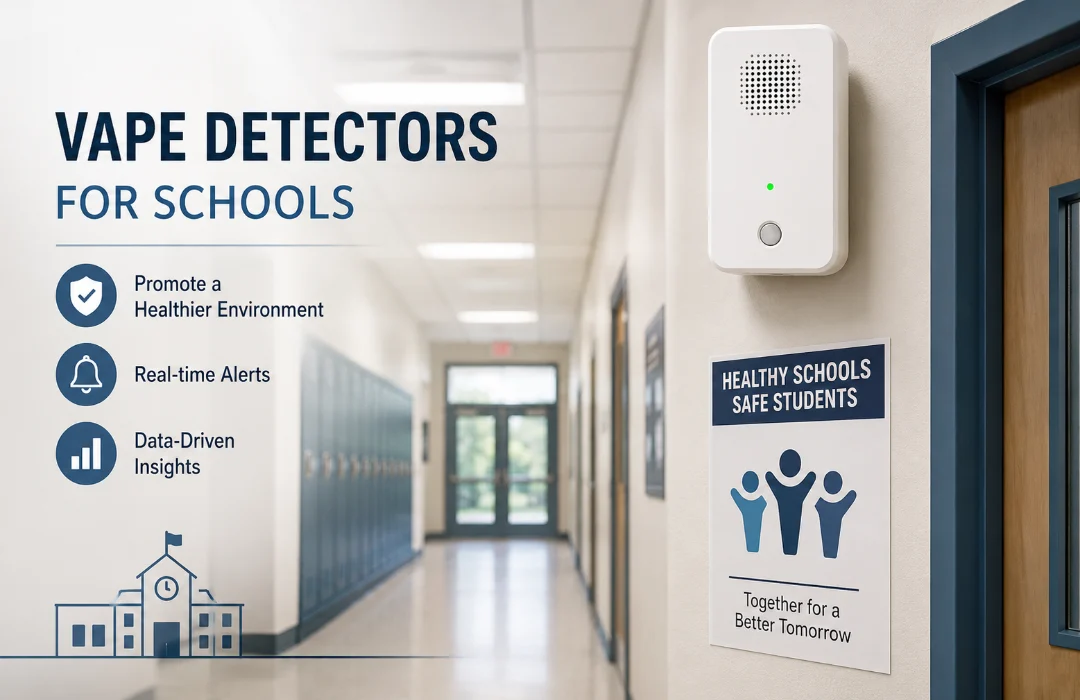
Most school vape detectors look like small ceiling-mounted or wall-mounted devices. They may resemble:
- Smoke detectors
- Carbon monoxide alarms
- Motion sensors
- Wi-Fi access points
- Compact air quality monitors
They are usually white or neutral in color and placed high on a wall or ceiling.
What does a vape detector look like in a bathroom?
A bathroom vape detector is often mounted:
- On the ceiling
- High on a wall
- Near the center of the room
- Away from vents when possible
It usually does not have a camera. A proper school bathroom vape detector should monitor air quality, not record students.
Where Should Schools Install Vape Detectors?
Placement is one of the biggest factors in system success. Even the best vape detectors for schools will perform poorly if placed in the wrong locations.
Best Installation Areas
The most common installation points include:
- Student bathrooms
- Locker rooms
- Secluded hallways
- Stairwells
- Athletic facility restrooms
- Auditorium or event restrooms
- Bus loading areas if enclosed or partially enclosed
Bathrooms are usually the first priority because they are enclosed and difficult to supervise.
Areas Where Placement Is Less Effective
Vape detectors may be less effective in:
- Outdoor areas
- Large open cafeterias
- Highly ventilated spaces
- Areas near strong HVAC airflow
- Spaces with frequent aerosols from cleaning products
Schools should conduct a site review before purchasing devices.
How Sensitive Are Vape Detectors?
Vape detectors can be very sensitive, but sensitivity varies by brand, model, calibration, and environment.
A detector may respond to:
- A small amount of aerosol in an enclosed bathroom
- Repeated vaping in the same space
- Strong chemical signatures
- Sudden particulate spikes
But sensitivity must be balanced carefully. If the device is too sensitive, it may produce false alerts. If it is not sensitive enough, it may miss incidents.
Common false alert sources may include:
- Aerosol sprays
- Strong cleaning products
- Perfume
- Dust
- Steam
- HVAC changes
High-quality systems use multiple sensors to reduce false positives.
What Happens When a School Vape Detector Goes Off?
When a school vape detector goes off, the response depends on the school’s policy.
A typical workflow may look like this:
- Sensor detects possible vape aerosol
- Alert goes to designated staff
- Staff checks the location
- Hallway cameras may be reviewed if available
- Students leaving the area may be identified
- Staff follows the school’s disciplinary or wellness policy
- Incident is logged for reporting and trend analysis
The best schools do not rely only on punishment. They combine detection with education, parent communication, and cessation resources.
Privacy Considerations for Vape Detectors in Schools
Privacy is a major concern, especially when devices are installed in bathrooms.
A responsible school vape detection program should follow these principles:
No Cameras in Bathrooms
A vape detector should not include video recording inside private spaces.
No Audio Recording
If sound detection is included, the system should measure decibel levels only, not record conversations.
Clear Communication
Schools should inform students, parents, and staff that vape detectors are installed and explain what data is collected.
Written Policy
A school should document:
- Where detectors are installed
- Who receives alerts
- How data is stored
- How long data is retained
- What happens after an alert
- How false positives are handled
This helps build trust and reduce confusion.
Vape Detectors for Schools Cost
The cost of vape detectors for schools can vary widely.
Factors that affect cost include:
- Number of units
- Sensor quality
- Cloud software fees
- Installation requirements
- Network wiring
- Integration with cameras or access control
- Maintenance and calibration
- Warranty and support
A simple unit may cost a few hundred dollars, while enterprise-grade systems can cost significantly more per sensor, especially when software subscriptions and installation are included.
Schools should budget for:
- Device cost
- Installation labor
- Network cabling
- Software licenses
- Annual maintenance
- Staff training
The cheapest option is not always the best. A low-cost detector with frequent false alerts can create staff fatigue and reduce trust in the system.
Best Vape Detectors for Schools: What to Look For
Instead of focusing only on brand names, schools should evaluate features.
Important Features
A strong school vape detector should include:
- Multi-sensor detection
- Real-time alerts
- Cloud dashboard
- Tamper detection
- Adjustable sensitivity
- Event logging
- Privacy-safe design
- Easy installation
- Strong support
- Integration options
Some schools consider well-known systems such as HALO Smart Sensor or other specialized vape detectors. The best choice depends on the school’s building layout, budget, privacy requirements, and response plan.
Vape Detectors for Schools Reviews: What Matters Most
When reading vape detectors for schools reviews, focus on operational performance, not marketing claims.
Look for reviews that discuss:
- False alert rate
- Ease of installation
- Dashboard usability
- Alert speed
- Calibration process
- Customer support
- Long-term maintenance
- Student behavior changes
- Integration with existing systems
A review that only says “it works” is not enough. Schools need to know how it performs in real bathrooms, with real HVAC systems and real student behavior.
Vape Detectors vs Metal Detectors at School
Many students and parents also ask: do vapes go off in metal detectors at school?
The answer is: sometimes.
Metal detectors detect metal parts in vape devices, such as:
- Batteries
- Coils
- Circuit boards
- Metal shells
- Charging ports
A disposable vape may trigger a metal detector if the detector is sensitive enough. Larger vape devices are more likely to be detected.
However, metal detectors and vape detectors serve different purposes.
| Device | Detects |
|---|---|
| Metal detector | Metal objects in bags or pockets |
| Vape detector | Vape aerosol in the air |
| Smoke detector | Fire smoke |
| Security camera | Visual activity in public areas |
A school may use multiple tools together, but each tool has a different role.
Do Vape Detectors Work in Hotels, Homes, and Hospitals?
Although this article focuses on schools, vape detectors are also used in other environments.
Hotels Vape Detector
A hotel vape detector may be installed in rooms or hallways to enforce no-smoking policies.
Hospitals
Hospitals may use vape detectors to protect patients and maintain clean indoor air.
Homes
A vape detector for home exists, but home use is less common than school or hotel use.
Commercial Buildings
Office buildings may use portable vape detectors or permanent sensors in bathrooms and shared spaces.
Should Schools Recommend Vape Brands?
Schools should not promote vaping products to students. For a school-focused article, any brand mention should be framed responsibly.
For adult consumers outside the school context, established vape brands such as MR FOG are often recognized for product consistency and device innovation. However, school vape detector policies should focus on preventing underage vaping and supporting student health, not encouraging vape product use.
Common Mistakes Schools Make With Vape Detectors
Mistake 1: Installing Detectors Without a Policy
Technology without policy creates confusion. Schools should define exactly what happens after an alert.
Mistake 2: Over-Relying on Punishment
Suspensions alone may not address nicotine dependence. Counseling and cessation support are important.
Mistake 3: Ignoring Calibration
Every building has different airflow, ceiling height, and cleaning routines. Calibration is essential.
Mistake 4: Not Training Staff
Staff need to understand how alerts work, how to respond, and how to document incidents.
Mistake 5: Poor Parent Communication
Parents should know why detectors are installed and what privacy protections exist.
How Schools Can Build a Better Vape Prevention Program
A strong program includes more than sensors.
Schools should combine:
- Vape detectors
- Student education
- Parent communication
- Counseling resources
- Clear policies
- Staff training
- Incident tracking
- Fair discipline
- Anonymous reporting tools
This creates a balanced approach that supports both enforcement and student wellness.
Frequently Asked Questions
1. What are vape detectors for schools?
Vape detectors for schools are air-monitoring devices that detect vape aerosol, chemicals, and air quality changes in places like bathrooms and locker rooms. They help school staff identify possible vaping incidents in areas where cameras cannot be used.
2. How do vape detectors work in schools?
They use sensors to detect fine aerosol particles, chemical compounds, VOCs, humidity changes, and sometimes sound level changes. When possible vaping is detected, the system sends an alert to school staff.
3. Do vape detectors in school bathrooms work?
Yes, they can work well when installed and calibrated correctly. Bathrooms are enclosed spaces, so vape aerosol can accumulate quickly and trigger the detector more reliably.
4. What do vape detectors look like?
Most vape detectors look like small smoke detectors, carbon monoxide alarms, motion sensors, or air quality monitors. They are usually mounted on ceilings or high walls.
5. Can smoke detectors detect vape?
Standard smoke detectors usually do not reliably detect vape aerosol. They are designed for fire smoke, while vape detectors are designed for aerosol and chemical changes.
6. Do vapes go off in metal detectors at school?
Sometimes. Vapes contain batteries, coils, and metal parts, so sensitive school metal detectors may detect them.
7. How much do vape detectors for schools cost?
Costs vary widely depending on sensor quality, installation, software, wiring, and support. Schools should budget for devices, setup, software subscriptions, maintenance, and staff training.
8. Are vape detectors real?
Yes. Vape detectors are real and are used in schools, hotels, hospitals, offices, and public buildings to detect vaping-related aerosol and air quality changes.
9. Do vape detectors record video or audio?
Most proper vape detectors do not record video or audio. Some may measure sound levels, but privacy-safe systems should not record conversations, especially in bathrooms.
10. What do vape detectors detect?
They detect vape aerosol particles, chemical markers such as PG/VG, nicotine-related compounds, VOCs, humidity spikes, and sometimes THC-related substances depending on the system.
Final Thoughts
Vape detectors for schools can be a useful tool for reducing vaping in bathrooms, locker rooms, and other hard-to-monitor spaces. They work by detecting aerosol particles, chemical compounds, and air quality changes—not by recording students.
However, technology alone is not enough. The most effective school programs combine vape detectors with clear policies, student education, counseling support, parent communication, and consistent staff response.
When used responsibly, vape detectors can help schools create a cleaner, safer, and more focused learning environment.
 ELITE
ELITE SWITCH POD SPLASH
 SWITCH POD
 AURA SPLASH
 AURA
AURA NOVA Apple Steezy
 NOVA Banana Steezy
 NOVA Popup Series
 NOVA Bubble Gang
 NOVA Lemon Steezy
 NOVA Series
 Blue Razz Steezy
 Mellow Man
 Apple Steezy
 Banana Steezy
 Berry Steezy
 DRT
DRT SWITCH POD
 Nicotine Pouches